The decision most Ocala customers face is weekly versus twice weekly, and headcount decides it more than anything else. A single standard unit is built for roughly one week of use by a small crew — think a four- to…
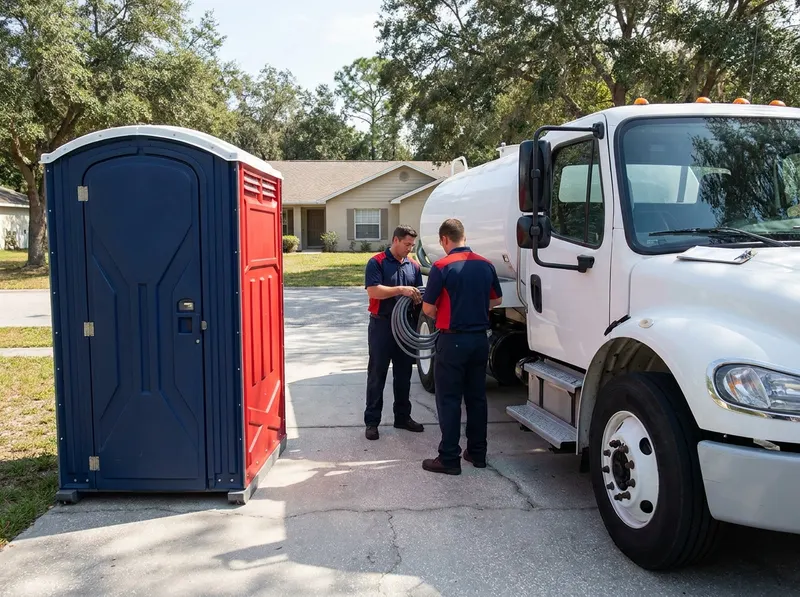
The decision most Ocala customers face is weekly versus twice weekly, and headcount decides it more than anything else. A single standard unit is built for roughly one week of use by a small crew — think a four- to six-person remodel crew on an infill lot in Silver Springs Shores or a slab-to-finish house in Marion Oaks. Push 15 or 20 workers through that same unit and the tank fills before the route comes back around, which is when odor complaints and paper shortages start. The trade-off is straightforward: a second weekly visit costs more per month, but it is the only thing that keeps a high-traffic unit acceptable between stops. Marion County heat is the other factor. From May through September, a unit parked with no shade on a Fore Ranch or Heath Brook commercial pad off SR 200 works harder than the same unit under oaks in Woodfields, and afternoon thunderstorm humidity makes deodorizer burn off faster. We will tell you plainly at delivery which category your placement falls into instead of selling you frequency you do not need.
Route access is the part that quietly decides whether a visit happens on schedule. The service truck needs to get within reasonable hose reach of the unit on firm ground — sandy shoulders and soft fill on a fresh pad in Bellechase or Meadow Wood Farms are the usual culprits, and a truck that sinks helps nobody. Keep the unit within about 50 feet of a driveable surface, leave the front of the unit clear, and do not park trailers or dumpsters in front of the door. Gated communities matter here: On Top of the World, Ocala Palms, Golden Hills Turf & Country Club, and Bellechase all need a gate code, a call-box name, or a barn or contractor entrance noted on the work order before the first visit, or the driver burns the stop. Farm placements around the World Equestrian Center and Meadow Wood Farms should note whether dogs are loose and whether the gate is chained. If a unit is moved on site between visits — common as framing progresses — a quick call to (352) 329-9734 keeps the driver from hunting for it.
Events run on a different clock. A weekend gathering near Tuscawilla Park or Sholom Park usually needs one service before or after, not a weekly cycle. Multi-day activity is where scheduled pump-outs earn their keep: show weeks at HITS Post Time Farm, longer bookings at the Florida Horse Park, and staged crowds around Silver Springs State Park all benefit from a mid-run service so the last day looks like the first. Restock volume is often the real driver at events, not tank capacity — paper runs out long before a tank does when a few hundred people share a bank of units. Placements deep toward the Ocala National Forest, where the last stretch is unpaved, are quoted with drive time and access noted up front rather than surprising you later.
Pricing on service is deliberately unfussy. Weekly service is stated in the monthly rate — it is not a line item that appears on invoice number two. Extra visits, added units, and long-distance placements change the number, and we say which one applies before the truck rolls. Every figure below is a ballpark; the exact number is confirmed after a free on-site look at access, distance, and expected headcount, and no invoice goes out below our $250 minimum. Dropped on time. Serviced on schedule.
Every job gets a firm, written price after a free on-site visit.
Tell us about your weekly service & pump-out visits job in Ocala and we'll send a clear, written quote — usually the same day.
 BluePeak Porta Potty Solutions